
The renewed Australian Animal Welfare Strategy
Strong evidenceDepartment of Agriculture, Fisheries and Forestry
Applied Animal Welfare
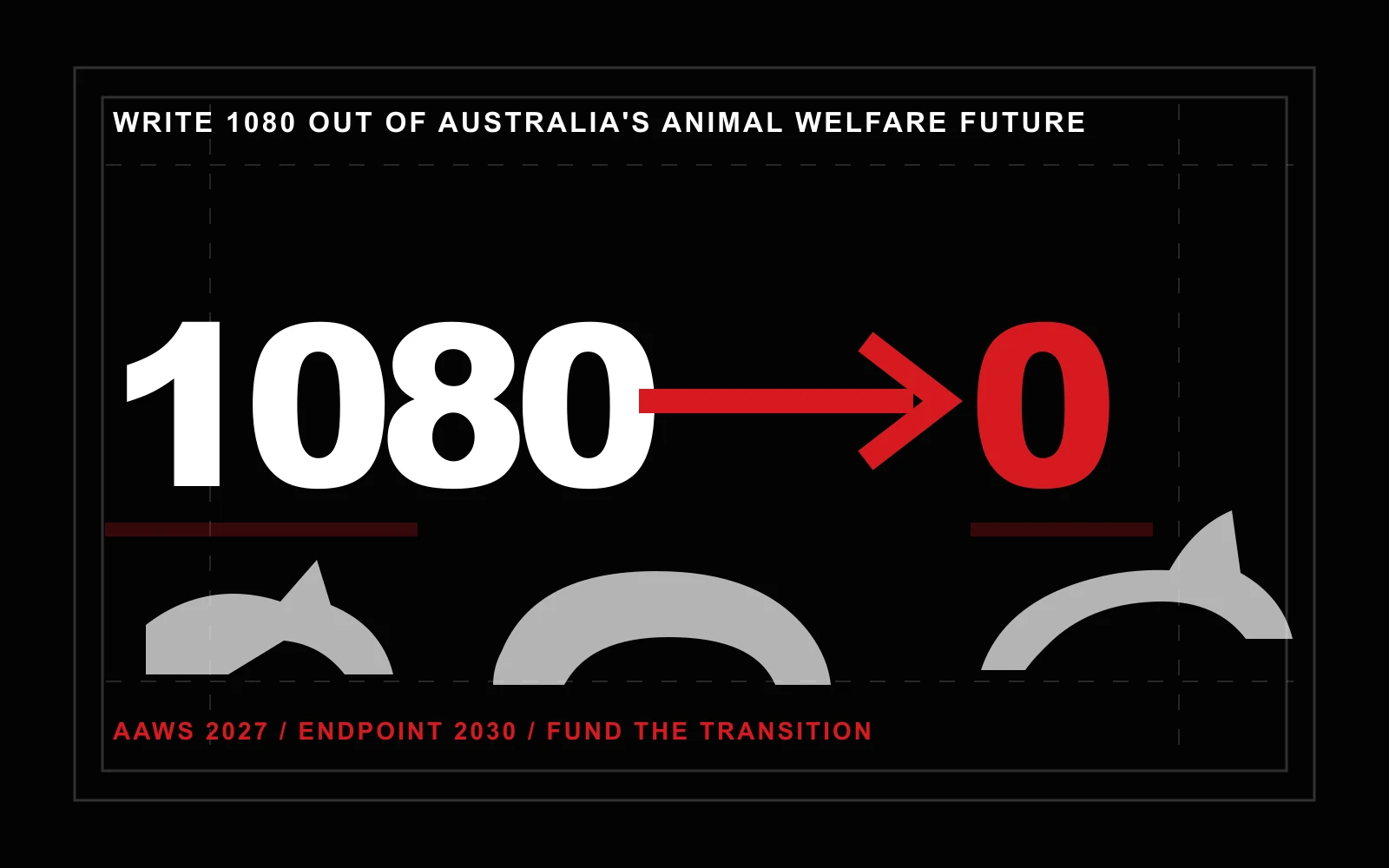
1080 has no place in Australia's animal welfare future. Through the renewed Australian Animal Welfare Strategy, Bite Back is seeking a nationally coordinated and legally implemented end to 1080: replace existing programs with effective lower-welfare-impact methods, reform the regulatory system that continues to authorise it and prohibit all remaining use by 2030.
Learn the issue
Australia continues to authorise and deploy 1080 despite evidence that poisoning can cause severe and prolonged suffering, expose companion and non-target animals, and occur without consistent national reporting of quantities used, locations, outcomes or adverse incidents. The regulatory framework compounds this failure because the welfare of the deliberately targeted animal is not presently a standalone criterion determining whether an agricultural or veterinary chemical may be approved or remain registered. This omission allows a poison with serious and avoidable welfare impacts to remain embedded in government conservation, biosecurity and livestock-protection programs.
Read the evidence
The available evidence does not support describing 1080 as humane. Documented poisoning effects include severe neurological and behavioural distress, convulsions and potentially prolonged suffering. Government and animal-welfare assessments identify methods with lower relative welfare impacts for several major applications, including PAPP for foxes and wild dogs and sodium nitrite for feral pigs, together with targeted shooting, exclusion, guardian-animal programs and other integrated controls where appropriate. The APVMA's previous 1080 review recorded substantial humaneness concerns but acknowledged that target-animal welfare was not a statutory criterion on which registration could be determined. The evidence supports immediate replacement wherever established alternatives are suitable, a funded and time-limited transition for more difficult applications, and legislative reform ensuring that severe avoidable suffering can no longer be excluded from chemical approval decisions.
Evidence status: Moderate evidence.
Campaign severity: Extreme severity.
Legal or policy pathway
The renewed Australian Animal Welfare Strategy should establish elimination of 1080 as an agreed national policy and implementation commitment under its Animals in the Wild chapter, endorsed through the Animal Welfare Task Group, Agriculture Senior Officials' Committee and Agriculture Ministers' Meeting. The Commonwealth should then amend the Agricultural and Veterinary Chemicals Code to make target-animal welfare and the availability of effective lower-impact alternatives mandatory approval and reconsideration criteria, impose a statutory 2030 sunset on 1080 approvals and registrations, and translate the intergovernmental commitment into formal policy and ministerial direction to the APVMA. The APVMA should reconsider and withdraw all relevant active-constituent approvals, product registrations, labels and permits. States and territories should concurrently prohibit the supply, possession and use of 1080 through their chemical-control laws, authorisations, operating standards, procurement rules and public-land management programs, completing a nationally consistent prohibition by 31 December 2030.
Desired outcome: Australia permanently ends the use of sodium fluoroacetate, or 1080, for vertebrate animal control by 31 December 2030. The renewed Australian Animal Welfare Strategy establishes this as an agreed national commitment and requires the Commonwealth, states and territories to implement a coordinated phase-out, regulatory prohibition and funded transition to effective methods with lower animal welfare impacts.
Measurable endpoint: The final 2027 Australian Animal Welfare Strategy includes an explicit national commitment to eliminate 1080 by 31 December 2030, supported by published implementation milestones, Commonwealth reform of the agricultural and veterinary chemical approval framework, formal APVMA reconsideration and withdrawal of relevant approvals, corresponding state and territory prohibitions, funded replacement programs, annual public reporting and independent assessment of every remaining use during the transition.
1080 to Zero
This action is not live until representative matching, ministerial target lists, consent wording, delivery logs and export processes have passed testing.
Address data is required only for representative matching and stays with the configured advocacy provider.
Track the outcome
The campaign is scoped around a national AAWS commitment, immediate replacement where lower-impact methods are suitable, funded transition for unresolved uses and public reporting of 1080 deployment and incidents.
FoundationRelevant news
Agriculture Victoria's review compares 1080 with alternatives including PAPP, sodium nitrite and shooting, identifying lower relative welfare impacts for several applications while noting cost, evidence and operational limits.
Department of Agriculture, Fisheries and Forestry
Department of Agriculture, Fisheries and Forestry
Department of Agriculture, Fisheries and Forestry
Department of Agriculture, Fisheries and Forestry
Australian Pesticides and Veterinary Medicines Authority
Australian Pesticides and Veterinary Medicines Authority
RSPCA Australia Knowledgebase
Agriculture Victoria
PestSmart
PestSmart
PestSmart